
Weather and Separation Anxiety Training
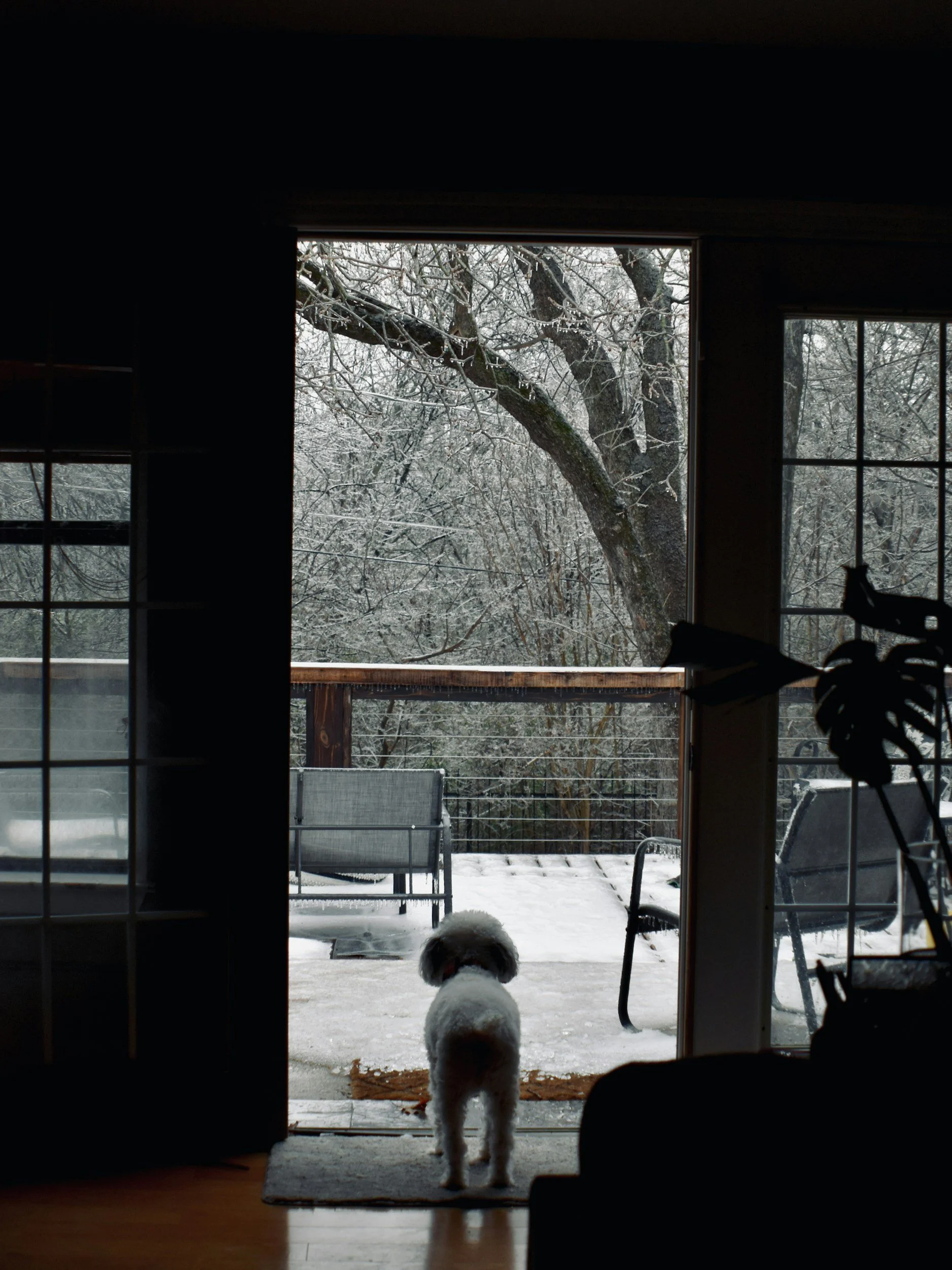
Weather is HARD! It is totally out of our control…
This article is intended for folks who are familiar with the separation anxiety protocol. If you are new, you may wish to read How to Start or How Does it Work first. While I focus on separation anxiety, these concepts can also be useful when talking about other big feelings and reactivity too!
Every dog may respond to weather events differently. It is important to observe your dog carefully to know how they respond to different weather before you try a mission or assessment.
Assessing a dog’s level of stress is sometimes straightforward if they are overtly displaying stress behaviors (shivering, hiding, whining), but it is not always so obvious. One way to gauge a dog’s discomfort is by offering a high-value treat during the weather event in question. If a dog is unable to eat high value treats, then they are probably stressed or overstimulated. For dogs who eat even when stressed, you may instead ask them for different cues to see how quickly they respond. If they hesitate more than usual or outright cannot respond to some cues, then this can also be an indicator that they are uncomfortable (this is a great callout that dogs who “refuse” cues sometimes are not “stubborn” but are experiencing such big emotions that they are struggling). So, what should we do when we know our dog is unhappy or even terrified during weather events?
Avoid or Modify Practice – Make it Easier
Storms and weather events can reduce how long a dog can be alone. Based on your dog’s stress level, you may want to lower the difficulty of your steps and the duration of your absences. Depending on your dog’s stress, you may decide not to practice that day or in those weather conditions.
We aren’t going to ignore weather forever. Weather desensitization is important, separation desensitization is important, but we can’t always start with both at the same time. It is important to work with your trainer and veterinary medical team to decide exactly what combinations of training can be constructive for your dog. Combining too early can result in what we call trigger-stacking and may be counter-productive for both desensitization goals. Trigger stacking is when separate triggers are experienced close enough together that a dog has not fully recovered (physically, mentally and/or emotionally), resulting in a bigger response to follow-on or simultaneous triggers. We want to keep all our practice absences feeling very safe and only incorporate other potential triggers once the alone time itself is not triggering anymore.
This same principle applies to other big feelings practice too! I would not try to challenge my reactive/over-excited dog, who also dislikes rain, to walk directly toward another dog with our 1,2,3-treat practice if it is raining. This might result in my dog already starting practice uncomfortable, irritable, and possibly feeling unsafe – and then having an even bigger reaction to that dog instead of benefitting from the game that is supposed to create predictability and safety.
If a dog shows only mild discomfort or you aren’t sure how much the weather affects them, it is okay to attempt your usual separation practice. Keep detailed notes and data about the weather and make sure to rate your practice session based on your dog’s behavior. This way you can always go back and check if any type of weather consistently changed how your dog responded.
If at any point your dog becomes excessively distressed, return immediately as per the general separation training advice.
Masking and Covering
If the sound of weather bothers your pup – like rain on the roof or wind whistling by – then playing calming or masking sound might help. The masking sound won’t fully hide the sound, but the idea is to have something in the environment that is more present for your dog than that outside noise. There are a lot of choices for masking sounds so I recommend playing these sounds at a calm time when you are around and the trigger is not happening to see how your dog responds to them. If their response is calm, neutral, or nothing then it may be the right sound!
Common choices for calming/masking sounds:
Brown, pink, or white noise
Mellow classical music (but make sure it does NOT contain the sudden big bangs or clashes that can sometimes sound like thunder and lightning!)
Soft reggae (yeah, there is a study that suggests soft reggae is calming for a lot of dogs – but remember every dog is an individual and can respond uniquely to different sounds)
Through a Dog’s Ear/iCalmPet – they have some great albums all geared towards calming pets
Music that you usually listen to – sometimes sound that are most familiar are the most calming, just make sure you are playing the calmest part of your playlist
Check out my Music and Dogs blogcast for more information!
If your dog is visually overstimulated by a weather event then, instead or in addition to playing masking sounds, you may want to cover your windows – but this depends on the dog.
Secure black out curtains may be able to block out the scary light from lightning to at least take away one aspect of storms. Nothing can really mask the rumble from big thunder nor the static – but every part of the storm that we mitigate may help. If rain or snow is over-exciting for your dog then curtains may help take away one distraction while you practice at home.
Some dogs won’t find curtains helpful. Especially if they find it soothing to see what’s going on outside and where their person goes after exiting the door. You will need to judge what combination of adjustments is right for your dog. If you are thinking that these are a lot of factors to account for and balance – you are right! This is one of the reasons it can be helpful to work with an experience Certified Separation Anxiety Trainer (CSAT).
A quick review of Weather Desensitization, Counter Conditioning, and Socialization
A quick explanation on those terms:
Counter Conditioning – a behavior modification technique where a certain stimulus that creates a negative emotional response is paired with something that is known to cause a positive emotional response to change the negative emotional response. This change may also be intended to change the behavior that occurs as a result of the negative emotional response.
Desensitization – the reduction or elimination of emotional and/or physical reactivity to a stimulus after repeat exposure
Socialization – an intentional and careful process of exposing puppies 3-14 weeks old to a variety of stimuli in positive ways to build positive associations, prevent fears or anxiety, and promote confidence and friendliness
Like I said earlier, you are ideally breaking out your pup’s anxieties to work on them one at a time to avoid trigger stacking.
For young puppies who are still in their socialization period, you should intentionally (but carefully) expose them to weather sounds and experiences with lots of treats, play, and positive experiences. If you want to know more about socializing a young puppy, here is an excellent resource: https://puppysocialization.com/
If you are working with a dog older than 14 weeks or a puppy who has already had a negative experience with weather and is showing stress – then instead we are talking about both careful exposure to weather (or parts of the weather) and pairing that weather with things that cause a positive or opposite response – often food!
What can this look like?
Playing very quiet thunder sounds and giving lots of high value treats or play, working up to playing it louder (Counter condition). And repeat (Desensitization).
Getting a patch of grass or sidewalk wet and encourage walking over it for lots of nice goodies. Repeat in new ways and in new environments.
Work on very familiar and easy tricks/cues around the window or with the door open during easier weather events.